Software projects fail. More often than you’d think. In fact, according to the Standish Group’s CHAOS Report, only 31% of software projects succeed when rigid, outdated development approaches are used. The rest? They run over budget, miss deadlines, or get abandoned entirely.
That’s exactly why agile web development exists — and why it’s completely transformed how modern teams build websites and applications.
Whether you’re a business owner evaluating your options or a project manager tired of costly surprises, this guide breaks down everything: the definition of agile development, how it works, the frameworks behind it, and whether it’s right for your next project.
Let’s get into it.
What Is Agile Development? (The Real Definition)
So, what’s agile development, really?
At its core, agile development is a flexible, iterative approach to building software, where teams deliver working functionality in short cycles — rather than building everything at once and shipping it at the end.
The definition of agile development traces back to 2001, when 17 software engineers gathered in Snowbird, Utah, and published the Manifesto for Agile Software Development. They were frustrated with bloated processes, mountains of documentation, and projects that took years to deliver something users actually wanted.
Their solution? Four core values:
- Individuals and interactions over processes and tools
- Working software over comprehensive documentation
- Customer collaboration over contract negotiation
- Responding to change by following a plan
These agile principles weren’t just philosophical — they were practical. Teams that embraced them shipped faster, adapted quicker, and built products users actually loved.
“The agile model isn’t about chaos. It’s about structured flexibility — knowing when to pivot without losing sight of the goal.”
The meaning of agile development in today’s context goes further. It covers agile application development, agile website development, mobile apps, SaaS platforms, and complex enterprise systems. Wherever software is built, agile web development delivers results.
Agile Web Development Methodology and Process
Understanding the agile web development methodology means understanding its rhythm. Unlike linear approaches, agile development, simply put, is this: build a little, test a little, learn a lot — then repeat.
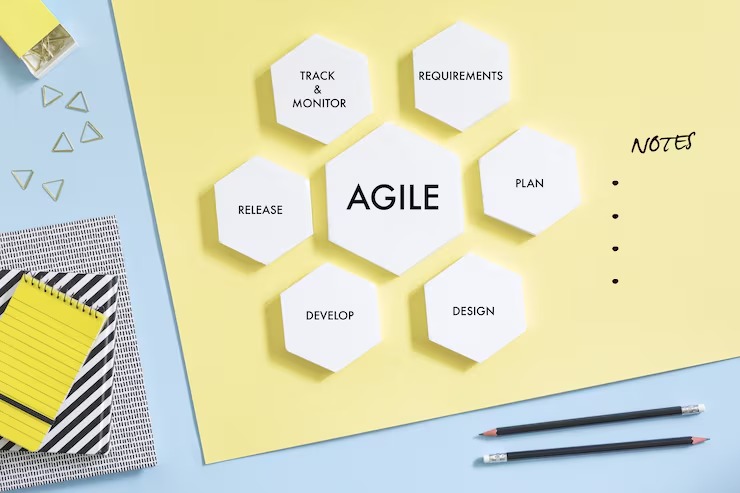
The agile development lifecycle follows a continuous loop of six core stages:
The Agile Process: Step by Step
| Stage | What Happens |
| Discover | Gather requirements, define user stories, and build the product backlog |
| Design | Wireframing, prototyping, UX/UI design workflow planning |
| Develop | Sprint execution — coding, front-end, back-end, full-stack development |
| Test | Continuous testing, agile quality assurance, bug tracking |
| Deploy | Production release, continuous delivery pipeline activation |
| Review & Iterate | Sprint review, stakeholder feedback, backlog refinement |
Each cycle — called a sprint — typically lasts one to four weeks. At the end of every sprint, the team delivers a working increment of the product. Not a document. Not a prototype. A working, testable piece of software.
Key Roles in an Agile Web Team
Cross-functional team collaboration is the engine of agile. Here’s who drives it:
- Product Owner — owns the product backlog, sets priorities, and represents the client’s vision
- Scrum Master — facilitates agile ceremonies, removes blockers, keeps the team moving
- Development Team — designers, developers, and QA engineers working in parallel
- Stakeholders/Clients — actively involved throughout, not just at the start and end
This agile team structure eliminates the painful handoff problem that plagues traditional development. Everyone works together, every single sprint.

Agile vs. Waterfall — What’s Actually the Difference?
This is where things get genuinely interesting. The waterfall vs agile methodology debate isn’t about which is “better” — it’s about which fits your situation.
Waterfall development follows a sequential project lifecycle. You complete Phase 1 before touching Phase 2. Requirements are locked upfront. Changes mid-project? Expensive and disruptive.
Agile web development does the opposite. It welcomes scope changes, integrates client feedback at every sprint, and delivers value continuously rather than in one massive release.
Here’s the honest comparison:
| Factor | Agile | Waterfall |
| Planning approach | Adaptive planning strategy | Upfront planning strategy |
| Delivery model | Incremental releases | Single production release |
| Flexibility | High — change-friendly process | Low — fixed requirement model |
| Client involvement | Every sprint | Mostly start and end |
| Testing | Continuous testing strategy | End of project |
| Risk exposure | Low — caught early | Highly discovered late |
| Best suited for | Evolving, complex projects | Fixed-scope, compliance-heavy builds |
When Waterfall Actually Makes Sense
Waterfall isn’t obsolete — it’s just misapplied. The rigid development structure works when:
- Requirements are completely fixed and won’t change
- You’re building for regulatory compliance requirements (government contracts, healthcare systems)
- The project has hardware dependencies where iteration isn’t physically possible
- Budget and timeline are locked with zero tolerance for change
Use the predictive development model when predictability is the entire point.
Agile vs. Traditional Web Development
Traditional development operated in silos. Designers handed off to developers. Developers handed off to QA. QA handed off to deployment. Each team waited for the previous one to finish.
The result? Months of work before anyone tested anything in a real environment. By the time bugs surfaced, they were catastrophically expensive to fix.
IT agile development dismantled those silos. Today, agile web dev means:
- Designers and developers collaborate from day one
- Continuous integration keeps code in a deployable state at all times
- Daily standup meetings (15 minutes, standing up) keep everyone aligned without wasting hours in conference rooms
- Client feedback loops after every sprint replace the dreaded quarterly status report
The agile software development process doesn’t just move faster — it catches problems earlier, at a fraction of the cost of fixing them post-launch.
Core Components of Agile Web Development
The agile web development methodology isn’t one single thing. It’s a collection of interconnected components that, together, create a fast, flexible, adaptive development model.
Sprint-Based Development
Sprints are the heartbeat of agile. Each sprint — typically two weeks — includes:
- Sprint planning process: team selects items from the product backlog
- Sprint execution: actual development, testing, and design work
- Sprint review: demo to stakeholders, gather feedback
- Retrospective: what worked, what didn’t, how to improve
Product Backlog & Prioritization
The product backlog is a living, prioritized list of everything the product needs. The backlog refinement process happens continuously — new insights get added, outdated items get removed.
Task prioritization ensures the highest-value features ship first. Not the easiest ones. The ones that matter most to users.
Continuous Integration and Testing
In agile application development, code is integrated and tested continuously — not in a single massive batch at the end. This continuous integration process means:
- Bugs get caught within days, not months
- The codebase stays stable sprint after sprint
- Test-driven development (TDD) bakes quality in from the start
UX/UI Design Workflow
Wireframing, prototyping, and usability testing methods happen early and iteratively. UX isn’t a phase — it’s a continuous practice embedded throughout the entire agile release cycle.

Agile Development Frameworks: Scrum, Kanban, and More
The agile model isn’t one-size-fits-all. Several frameworks implement agile principles differently, each suited to different team types and project needs.
What Is Scrum?
Scrum is the most widely adopted agile framework. It organizes work into time-boxed iterations (sprints) with clearly defined scrum team roles and agile ceremonies.
What is the Scrum development process? It runs like this:
- The Product Owner prioritizes the sprint backlog from the larger product backlog
- Team commits to completing selected items within the sprint
- Daily scrum meetings (standups) keep everyone synchronized
- Sprint review presents the increment to stakeholders
- Retrospective drives continuous improvement
Scrum works best for teams building complex, evolving products where requirements shift regularly.
What Is Kanban?
Kanban ditches sprints entirely. Instead, it uses a kanban board to visualize work flowing through stages — To Do, In Progress, Done.
The secret weapon? Work-in-progress (WIP) limits. By capping the number of tasks that can be active simultaneously, Kanban forces teams to finish work before starting new items. This creates a continuous flow system that dramatically reduces bottlenecks.
Kanban’s lean development process suits support teams, maintenance workflows, and situations where new requests arrive unpredictably.
Scrum vs. Kanban: Which Fits Your Team?
| Scrum | Kanban | |
| Work cadence | Fixed sprints | Continuous flow |
| Change tolerance | Between sprints | Anytime |
| Defined roles | Yes (PO, SM, Dev Team) | No required roles |
| Best metric | Velocity | Cycle time |
| Ideal for | New product builds | Ongoing maintenance |
Both are legitimate implementations of the agile delivery model. Many mature teams actually blend both — using Scrum for new features and Kanban for support queues.
Other Frameworks Worth Knowing
- SAFe (Scaled Agile Framework) — enterprise-scale agile across multiple teams.
- Lean Development — eliminate waste, maximize value-driven delivery
- XP (Extreme Programming) — engineering-focused, emphasizes agile programming practices like pair programming and TDD
The Real Benefits of Agile Web Development
Here’s why companies worldwide are switching to agile web development services — and not looking back.
Faster Time-to-Market
Rapid application development through sprint-based delivery means a working MVP can ship in weeks. Not quarters. Every increment delivers real value, letting businesses test ideas in the market before committing full resources.
Improved Customer Satisfaction
Clients aren’t passive observers in agile. They’re active participants. Regular sprint reviews, stakeholder communication, and the integration of genuine client feedback mean the final product actually matches what was needed — not just what was documented six months earlier.
Reduced Development Risk
In the waterfall development model, you discover problems at the end. In agile, continuous testing and iterative development surface issues early — when fixing them costs a fraction of what post-launch remediation costs.
“Catching a bug in sprint 2 costs $50. Finding it after launch costs $5,000. Agile makes that math work in your favor.”
Cost-Effective Development
Handling budget constraints is dramatically easier when work happens in increments. Teams can reprioritize mid-project based on what’s delivering value — eliminating wasted effort on features nobody actually uses.
Enhanced Transparency and Accountability
Every sprint produces visible, testable output. Stakeholders always know exactly where the project stands. No surprises. No “we’re 90% done” for three months straight.
Scalable Development Process
Whether you’re a startup building an MVP or an enterprise managing complex agile application development across dozens of teams, the scalable development process adapts. Add teams, add sprints, add frameworks — agile grows with you.
Is Agile Web Development Right for Your Project?
Not every project needs agile. Here’s a quick decision framework:
Agile is a strong fit when:
- Requirements are likely to evolve
- Speed to market matters more than upfront perfection
- Client involvement and feedback loops are possible
- The project is complex with many unknowns
Stick with a structured approach when:
- Scope is completely fixed and contractually locked
- Regulatory compliance requirements demand exhaustive documentation
- It’s a small, one-time build with no anticipated changes
How to Get Started With Agile Web Development Services
Starting your agile journey doesn’t require a complete organizational overhaul. Begin small:
- Pick one framework — Scrum if you’re building new features; Kanban if you’re managing ongoing work
- Build your backlog — gather requirements, write user stories, prioritize ruthlessly
- Run your first sprint — two weeks, one clear goal, daily standups
- Review and improve — use the retrospective to refine your process
Tools that support the agile workflow: Jira, Trello, Linear, and Notion.
The most common mistake? Treating agile as a process to follow rather than a mindset to adopt. Agile isn’t a checklist — it’s a culture of continuous improvement, adaptive planning, and relentless focus on delivering value.
Partner With an Agile Web Development Company That Delivers
Understanding agile is one thing. Executing it well is another.
Admark Digital is a full-service, agile web development company that brings genuine sprint-based development, cross-functional team collaboration, and customer-centricity to every project. From initial discovery and wireframing through deployment, post-launch maintenance, and ongoing support services — every phase is handled with precision.
🚀 Ready to build smarter? Contact Admark Digital today and launch your first agile sprint with a team that knows how to deliver.
Conclusion
Agile web development isn’t a trend. It’s the proven, battle-tested approach that the world’s most successful development teams rely on — because it works.
It works because it’s built around people, not processes. Around working software, not documentation. Around adapting to reality, not clinging to a plan made before anyone wrote a single line of code.
From the agile manifesto principles to sprint-based delivery, from Scrum’s structured ceremonies to Kanban’s continuous flow system — every piece of the agile methodology in web development exists for one reason: to help teams build better products, faster, with less waste and fewer risks.
Whether you’re defining your first agile development lifecycle or scaling an existing process, the fundamentals stay the same. Discover. Design. Develop. Test. Deploy. Improve. Repeat.
Admark Digital helps businesses at every stage of that journey — bringing agile web development services that combine technical depth with genuine strategic thinking.
Don’t leave your next project to chance. Get in touch with Admark Digital and build something that actually ships — on time, on budget, and built to grow.